
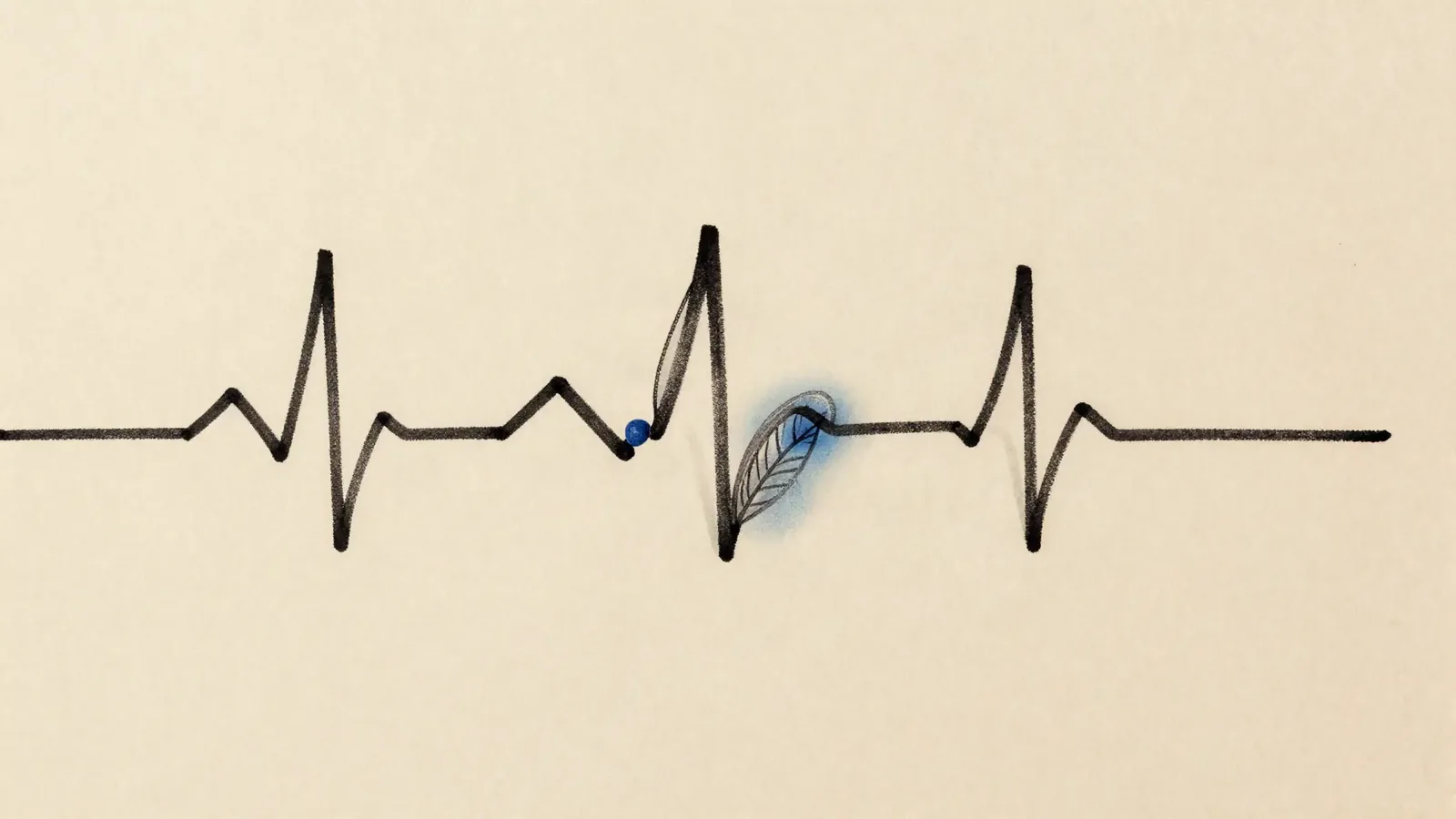
Five layers that must not be collapsed
Frequency & harmony
Frequency is a measurement property, not a universal healing mechanism. This world separates physical stimulation, biological rhythms, regulatory coupling, traditional harmony models and speculative hypotheses before any effectiveness claim is assessed.
WORLD-FREQUENCYReviewed 2026-07-29Version 2026.07.18.141. Physical frequency
Sound, vibration, light, electrical and electromagnetic stimulation can be measured. A usable record needs frequency or wavelength, amplitude or irradiance, waveform, pulse structure, exposure geometry, duration, dose and device. A result for one parameter set does not transfer automatically to another.
2. Biological rhythms
Breathing, heart-rate variability, baroreflex activity, sleep, circadian timing, neural oscillations and hormonal cycles are biological processes with different measurement methods. Their rhythms can interact, but shared periodicity does not establish one master frequency.
3. Regulation and coupling
Slow breathing can increase vagally mediated HRV during and after practice. HRV biofeedback often uses an individual or preset breathing pace near six breaths per minute, yet protocols are heterogeneous and frequently underreported. This measurable cardiorespiratory coupling is not proof for unrelated frequency products.
4. Traditional harmony models
Qi, prana, dosha balance, meridians, chakras and elemental systems should first be explained in their own traditions. They may generate research questions, but presenting them as measured electromagnetic fields without direct evidence changes the claim.
5. Speculative models
Biofield, remote action, information medicine and named 'healing frequencies' can be documented as hypotheses or commercial claims. They require pre-specified measurements, credible controls, replication and clinically meaningful outcomes. Unknown is the correct status when those data do not exist.
Light, music and vibration
No PBM effectiveness conclusion is published here. The internal photobiomodulation dossier is still being appraised. Future coverage must be specific to indication, population, device, wavelength, power, dose, schedule, tissue target, comparator and clinically meaningful outcome. Regulatory guidance or 510(k) clearance does not by itself establish clinical effectiveness. Music and vibration claims require the same intervention-specific appraisal.
Evidence
What this page can tell you
This is an orientation to a whole tradition or field, not proof that every treatment works. Specific practices, products and outcomes must be assessed separately, with uncertainty and source quality kept visible.
Continue exploring health
Choose another health perspective.
Move between traditions and topics without being diverted into commercial or administrative pages.
Visible safety boundary
Use context before action
Light can injure eyes and may interact with photosensitivity or photosensitizing medicines. Strong sound can damage hearing. Electrical or magnetic devices may be unsuitable with implants. Forceful or prolonged breathing can cause dizziness, panic, fainting or falls. Product-specific screening is required.
Source constitution
Bounded evidence and restricted regulatory records
The two research records support only the stated HRV measurement and methods claims. The FDA record supports regulatory-document status only. None establishes treatment benefit or validates a frequency product.
- Effects of voluntary slow breathing on heart rate and heart rate variability
SRC-HRV-META-2022systematic review meta analysisNeuroscience & Biobehavioral Reviews · 2022-07-01 · English
bounded editorial evidenceAllowed use: Supports selected HRV measurements only. HRV is a physiological proxy and does not by itself establish treatment benefit. Interest context: The article reports no funding source for the work and no author conflicts of interest. - Methods for Heart Rate Variability Biofeedback: systematic review and guidelines
SRC-HRVB-METHODS-2023systematic reviewApplied Psychophysiology and Biofeedback · 2023-03-16 · English
bounded editorial evidenceAllowed use: A methods review of protocol reporting, not an effectiveness review. Interest context: Government research grants are listed; open-access funding was provided by Universitat Autònoma de Barcelona; the authors declared no competing interests relevant to the article.