
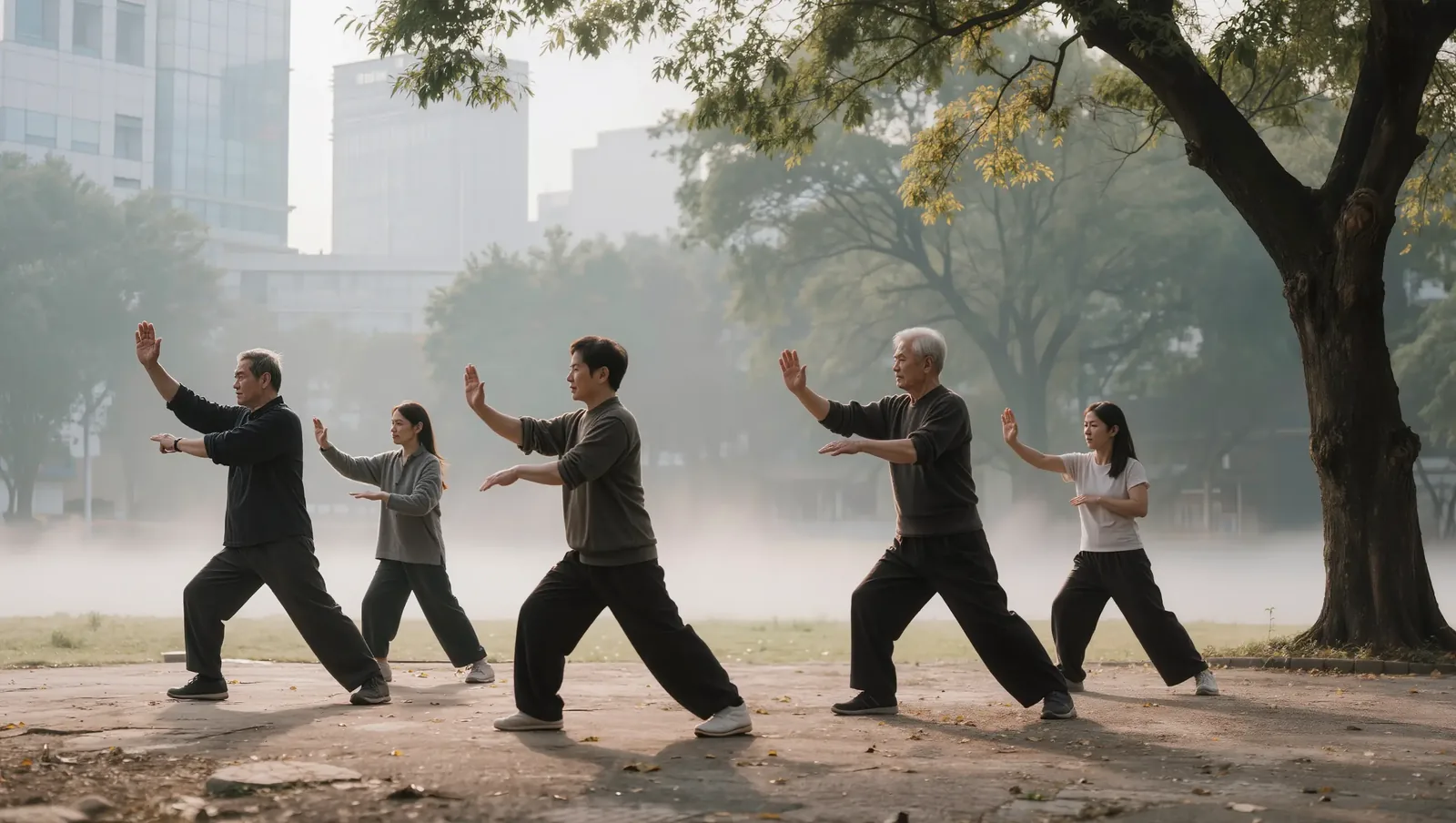
Movement, breath, attention and martial culture
Tai chi & qigong
Taijiquan and qigong are related but non-identical Chinese practice families. They can combine movement, posture, breath, attention, health cultivation and, for taijiquan, martial method. Clinical exercise protocols represent only one contemporary use.
WORLD-TAICHI-QIGONGReviewed 2026-07-29Version 2026.07.18.14Taijiquan as heritage
Taijiquan includes relaxed circular movement, coordinated breathing, attention, sequences, partner work and martial principles. Chen, Yang, Wu, Wu/Hao, Sun and other lines have distinct histories and pedagogy.
Qigong diversity
Qigong is an umbrella for many health, religious, martial and therapeutic practices. Static posture, dynamic movement, breathing, sound, imagery and attention can be combined in very different ways. A research report must name the actual set and teaching dose.
Clinical research
Tai chi studies report signals in balance, falls-related outcomes and selected chronic conditions. Comparisons with no exercise may look stronger than comparisons with other well-designed exercise. Small samples, diverse styles and differing duration reduce certainty for some outcomes. Qigong should not inherit taijiquan findings without protocol equivalence.
Safety and progression
Gentle forms are generally low risk, with aches and musculoskeletal discomfort most common. Low stances, rapid turns, prolonged standing and partner drills change load and fall risk. People with unstable cardiovascular symptoms, recent surgery, severe balance impairment or pregnancy should obtain appropriate guidance and modify practice.
What remains open
Research should compare named styles and doses, track instructor competence and adherence, use active comparators, report harms and examine whether social practice, attention, aerobic load or skill learning explains observed outcomes.
Evidence
What this page can tell you
This is an orientation to a whole tradition or field, not proof that every treatment works. Specific practices, products and outcomes must be assessed separately, with uncertainty and source quality kept visible.
Visible safety boundary
Use context before action
Choose a class matched to mobility and balance. Use support where needed, progress stance depth gradually and treat martial partner work separately from therapeutic exercise. New chest pain, fainting or acute neurological symptoms require urgent medical assessment.
Cultural context — not health evidence
Restricted cultural register record
The register entry establishes cultural-listing status only. It does not establish effectiveness, mechanism, safety or a complete definition of the tradition.
- Taijiquan - Representative List of Intangible Cultural Heritage
SRC-UNESCO-TAIJIcultural heritage recordUNESCO · 2020-12-17 · English
cultural register record onlyAllowed use: May establish only that Taijiquan appears on the named register. Interest context: Intergovernmental cultural-heritage register; not a clinical or scientific evidence body.
Continue exploring health
Choose another health perspective.
Move between traditions and topics without being diverted into commercial or administrative pages.